

This Orthodox Jewish Home Cook Brought His Faith to the Food Network’s Hottest New Show
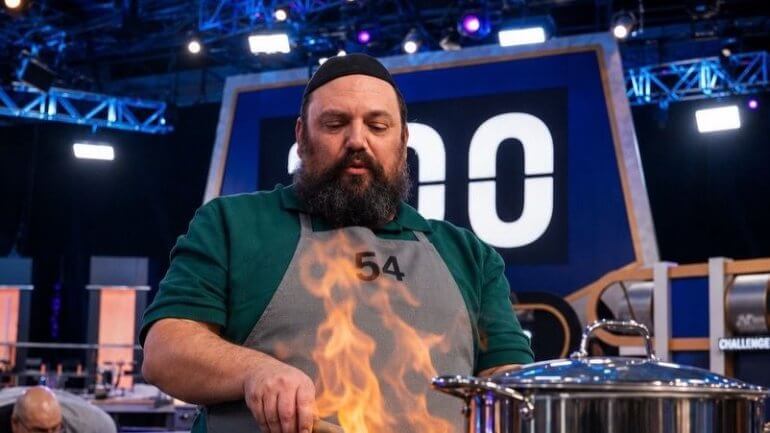
When Sruly Meyer got a message asking whether he would be interested in appearing on Food Network’s new competition show 100 Cooks, he assumed it wasn’t real.
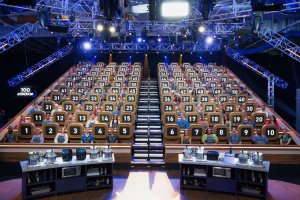
The South Florida food creator and marketing company owner had built a social media following by sharing recipes online on his Instagram @SrulyCooks, but national television felt like a different world entirely. Soon, however, he found himself packing for Los Angeles to compete alongside 99 other home cooks before celebrity judges including Alex Guarnaschelli and Nick DiGiovanni.
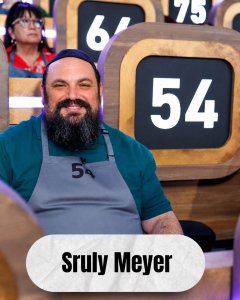
For Meyer, who grew up watching the Food Network, it was an exciting opportunity. It was also a nerve-wracking one. As a Chabad Jew, he looks visibly Orthodox with a beard, yarmulke, and tzitzit, so he knew he would stand out. He worried about how people would react to his observance and whether being visibly Jewish would become the focus of his experience rather than his cooking. In a post-October 7 world, he admitted, some of those fears ran even deeper.
Standing in his hotel room before mingling with the other contestants, Meyer found himself looking at the baseball cap he had worn while traveling. Keeping it on would have been easier. Easier, perhaps, than immediately identifying himself as the Orthodox Jewish contestant. Instead, he made a different decision.
“I’m not taking my baseball cap,” he remembered thinking. “I am obviously Jewish and I’m here to be a Jewish contestant and I’m kosher. Everyone’s gonna know that’s my story. So why not just be me?” It was a small decision, but by the end of the week, Meyer would come to see it as the right one.
Much of the anxiety he had carried into the experience began disappearing almost immediately. Before filming started, he explained to production that he kept kosher and would need kosher meals throughout the competition. Rather than treating it as an inconvenience, arranged for him to order from local kosher restaurants through Uber Eats. When Meyer raised another concern — that as an Orthodox Jew he would not be able to shake hands with female judges in accordance with the Jewish law of shomer negiah — he found the response equally reassuring. Production simply made note of it and moved on. “Everything I was worried about, there was nothing to worry about,” he said.
The contestants pleasantly surprised him too. When people learned that he would not be able to taste his own food because the kitchen wasn’t kosher, several immediately offered to jump in and taste on his behalf. Then, Shabbat brought some of the most memorable interactions of the entire experience.
While contestants spent the day making plans to explore Los Angeles, Meyer remained at the hotel. Throughout the day, people invited him to come along to restaurants, to Target, and to various outings around the city. Again and again, he explained that he couldn’t drive or ride in a car. Rather than finding his observance strange, many seemed genuinely intrigued by it. One contestant, a schoolteacher, was so moved that he stood up and addressed the group. “He says, ‘I just want to say that everyone here should be so inspired as I am inspired by Sruly, who keeps his faith,'” Meyer recalled.
For Meyer, the moment challenged many of the anxieties he had arrived with. The more openly Jewish he was, the more respect he seemed to receive in return. “They respect us more when we are who we are and not try to fit in or pretend,” he reflected. “Just be who you are.”
Meanwhile, there was still a cooking competition taking place. Because the kitchen wasn’t kosher, Meyer couldn’t taste a single thing he prepared. In front of an audience of millions, he explained, “As a kosher chef, if a kitchen isn’t kosher, I can’t eat anything out of it… I’m here to prove to myself that I can do this.”
He intentionally chose a dairy dish — a salmon penne alla vodka — then relied entirely on instinct. “My plan was just overdo everything,” he said with a laugh. “Overseason. Put more cheese.”
The gamble paid off. The judges enjoyed the dish and offered positive feedback, but Meyer ultimately wasn’t pushed through to the next round. Looking back, he believes not advancing may have been a blessing in disguise, as some of the later challenges would have created complications for his observance.
That conviction and Jewish visibility resonated beyond the set. After the episode aired, he received an unexpected FaceTime call from an unknown number but decided to answer anyway. On the other end was a Hasidic father (“with payos!”) whom he had met years earlier, sitting with his two children gathered around the phone. They had watched the episode together and wanted to tell him what it meant to them.
“You don’t know what it meant,” Meyer recalled the father saying, “that my kids are seeing a guy with a beard and a yarmulke on television.” The father told him that his children watched an Orthodox Jew stand confidently on national television, explain why he couldn’t taste non-kosher food, and compete without compromising his values.
After filming wrapped, one contestant reached out and told Meyer that watching him observe Shabbat had left a lasting impression. The contestant described feeling constantly overwhelmed by life and couldn’t stop thinking about the fact that Meyer had spent an entire day without a phone. “He said that he feels very overwhelmed by life and that he saw me on Shabbos and I didn’t have my phone and I looked carefree.”
Meyer explained that Shabbat is about connection — to God, family, community, and yourself. The contestant told Meyer he planned to start setting aside regular time each week to unplug and spend with family. “I think what you showed us is a beautiful thing,” he told him.
The positive feedback also came from a little closer to home. During our interview, a knock at the door interrupted our conversation. One of Meyer’s non-Jewish neighbors had stopped by after watching the episode and wanted to congratulate him. The interaction felt fitting. Meyer later explained that both he and the neighbor had once lived in Crown Heights, a Chabad-heavy area of Brooklyn, before eventually finding themselves living on the same block in Florida. “He loved the people there,” Meyer said.
Looking back, he realized that what stayed with him wasn’t whether he advanced in the competition or what the judges thought of his dish — though that was a dream come true, too.
Through conversations in hotel lobbies, questions about Shabbat, accommodations for kosher food, and a simple decision to leave a baseball cap behind, he found himself serving up something far more meaningful: an authentic picture of Orthodox Jewish life to people who might never have encountered it before. And judging by the contestants, neighbors, and Jewish children moved by his presence on and off camera, it was clearly a recipe that resonated.
If you found this content meaningful and want to help further our mission through our Keter, Makom, and Tikun branches, please consider becoming a Change Maker today.

 Related posts