

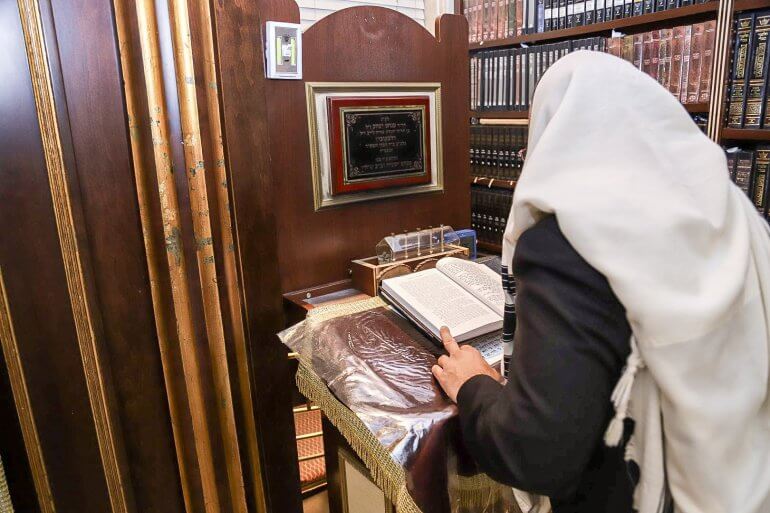

How Do Orthodox Jews Pray?
Dear Jew in the City,
How do Orthodox Jews pray?
Sincerely,
Kate
Dear Kate,
Thanks for your question. There are a lot of ways I could answer this. For example:
- How do we pray? In Hebrew (unless one is unable to do so).
- How do we pray? Standing. Many of us sway (called shuckeling).
- How do we pray? With great reverence.
- How do we pray? With great joy.
- How do we pray? Continuously, with three formal daily services (four on the Sabbath, five on Yom Kippur) and many informal prayers in between.
- Etc.
Since your question is open to interpretation, here is the approach I have chosen to take:
How do we pray? Optimally, we pray together in a quorum of ten adult Jewish males (the definition of “adult” for this purpose being thirteen years old). This quorum is called a minyan, and a minyan is necessary to recite certain prayers – including Kaddish – as well as for the public reading of the Torah. But that’s not actually the purpose of a minyan.
The Mishnah Brurah (90:28) writes that the reason to daven (i.e., pray) with a minyan is because God doesn’t reject the prayer of the community, even if there are unrepentant sinners among them. It’s better to pray in one’s house with a minyan than to pray in a shul (synagogue) without one.
The main part of our prayer service is the Shemoneh Esrei (the “eighteen benedictions”; a nineteenth was later added, but the name wasn’t changed). This prayer is recited silently by each individual but it should be recited collectively, i.e., everyone doing so all at once.
Continuing to quote the Mishnah Brurah, citing the Chayei Adam, many people think the purpose of the minyan is to be able to recite prayers like Kaddish and Kedusha, but that’s not it at all. The real reason is to enable us to pray together with the tzibbur (community).
Davening with the tzibbur is so important that a latecomer is permitted to skip parts of the service in order to start his Shemoneh Esrei with the congregation. (This leniency does not apply to a habitual latecomer; it’s a special dispensation to accommodate for the occasional mishap.)
Now, let’s say that someone is, for whatever reason, unable to attend the minyan. In such a case, one should at least try to daven at the same time as the minyan. While this may not count as tefillah b’tzibbur (communal prayer) per se, it still counts as a “time of (God’s) favor” (Brachos 8a).
Now let’s consider the text of Shemoneh Esrei. It begins “Blessed are You, Hashem, our God and God of our forefathers….” Not “my God” and “my forefathers,” but “our God” and “our forefathers.” It continues, in part:
- Favor us…
- Return us…
- Draw us near…
- Forgive us…
- Redeem us…
- Heal us…
- Bless us…
- Satisfy us…
- Gather us…
There’s more, but I think you get the idea, so let’s skip to the last bracha (blessing), which starts, “Place peace, goodness and blessing, favor, kindness and compassion on us and upon all Israel, Your people. Bless us, our Father, all of us as one with the light of Your countenance….”
While there are prayers in the liturgy in the singular (Modeh Ani, for example), most of our prayers – and in particular, Shemoneh Esrei – are in the plural. We don’t “look out for number one.” Rather, we recognize that we’re all in this together.
So, if you ask me, “How do Orthodox Jews pray?” – which you did – my answer is going to be “together.” Optimally, we do so literally, but we always do so at least metaphorically. The answer to “how do we pray” isn’t the “how.” It isn’t even the “pray.” It’s the “we.”
Sincerely yours,
Rabbi Jack Abramowitz, JITC Educational Correspondent
Educational Correspondent
Follow Ask Rabbi Jack on YouTube
If you found this content meaningful and want to help further our mission through our Keter, Makom, and Tikun branches, please consider becoming a Change Maker today.

 Related posts