
What Happens When Kosher Cuisine Earns a Michelin Star?
When Chef Raz Shabtai’s North Miami restaurant, Mutra, became the world’s first kosher restaurant to earn a Michelin star earlier this year, it marked a historic moment for kosher fine dining—and challenged long-held assumptions about what kosher cuisine can be. For Shabtai, who grew up in Jerusalem surrounded by his beloved grandmother’s cooking and hospitality, the recognition was also deeply personal, reflecting a journey back to his Jewish roots.
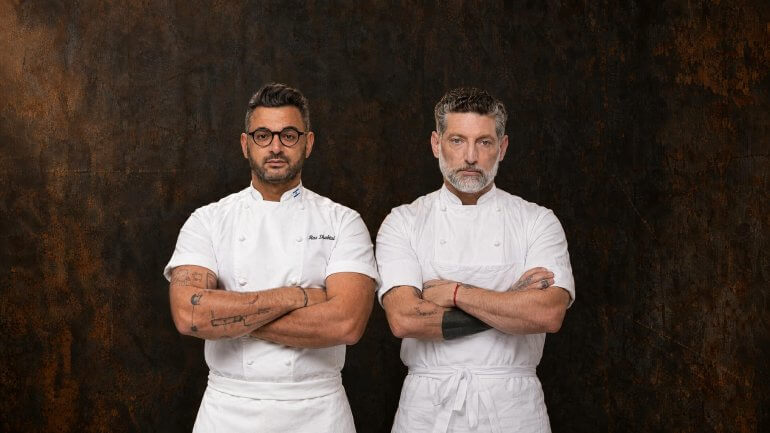
Now, Shabtai is taking that vision even further, welcoming internationally acclaimed, Michelin-starred Israeli chef Assaf Granit to Mutra for Granit’s U.S. dinner debut. The collaboration is part of a new international dinner series inviting acclaimed chefs to explore their culinary traditions through the creative framework of a kosher menu.
Ahead of the event, Shabtai sat down exclusively with Jew in the City to discuss his relationship with Judaism, the memories and traditions behind his cooking, and how he’s introducing kosher cuisine to new audiences without compromising its identity.
Talya Goldman: What role did Judaism play in your upbringing in Jerusalem? Was keeping kosher part of your life, and how has your relationship with Jewish tradition evolved as you’ve built your career as a chef?
Chef Raz Shabtai: I was born to a Jewish family in Jerusalem, and my grandma kept the Jewish tradition, so all the food that I ate growing up as a kid was kosher. I kept kosher for the majority of my life until I started to travel the world and wanted to explore and understand different types of cuisines and different flavors as a chef. My relationship with Judaism evolved and, at some point, I actually kind of lost myself along the way and felt that I was missing something – I missed my identity. I understood that I had to go back to my roots, to my memories, and to cook food in the same way I grew up with. It only felt right and natural to open Mutra as a kosher restaurant.
TG: For observant Jews, keeping kosher isn’t simply a dietary preference, but part of a larger religious way of life. Has working within those requirements influenced how you think about the relationship between food, faith, and creativity?
CRS: I believe food nourishes the soul as much as the body, and the principles behind keeping kosher remind us to be thoughtful about what we consume and how we treat others, including animals. The rules of kashrut challenge me to think differently, but I see that as an opportunity to create something beautiful, not a limitation.
TG: Jewish life has such a strong connection to food, from Shabbat and holiday meals to traditions passed down through generations. Are there particular Jewish memories, values, or traditions that influence how you cook or the experience you want to create for your guests?
CRS: My grandmother’s house in Jerusalem is the foundation of everything I do at Mutra. Every Friday before Shabbat, the doors were open, the music was playing, and neighbors would come in with their pots of food. People from different cultures and religions were always welcome. My grandmother didn’t have much, but she made her guests feel like they had everything. That’s what I remember most, and that’s what I’m trying to recreate at Mutra. I want our guests to feel like they’ve come into our home, where they’re welcomed with generosity, love, and a beautiful meal.
TG: Mutra recently made history as the first and only kosher restaurant to earn a Michelin star. What did that recognition mean to you personally, and what do you think it means for the future of kosher dining? Did you ever feel that operating a kosher kitchen would make achieving this kind of recognition more difficult?
CRS: When they announced our name, I was holding a picture of my grandmother. That moment was about so much more than a Michelin Star. I thought about her, my family, my team, and everyone who helped make Mutra possible. We earned that recognition by being true to ourselves, not by trying to cook for Michelin inspectors or becoming something that we’re not. I hope our Star inspires other chefs to see that kosher cooking can be just as ambitious, creative, and deserving of recognition as any other cuisine.
TG: There’s a perception that kosher food involves compromise, particularly when it comes to fine dining. What’s one dish or experience at Mutra that you think most effectively challenges that assumption? Can you walk us through how it came together?
CRS: One of the most personal dishes on our menu is Chicken Liver Dreaming to Be Foie Gras. My grandmother used to cook chicken liver because it was an inexpensive ingredient, but she knew how to make it taste incredible. I wanted to honor that memory by transforming something so humble into something extraordinary. Because of kosher preparation requirements, achieving the texture and richness I wanted was incredibly challenging. We kept working on it, giving that ingredient the attention and care it deserved, until we finally got it right. To me, that dish represents everything I believe about cooking. Something doesn’t have to be expensive or luxurious to be special. With enough love and creativity, you can make something extraordinary.
TG: Many observant Jews grow up accepting that certain experiences, including high-end dining, may not be accessible to them. What does it mean to you to offer a Michelin-starred experience where diners don’t have to choose between their religious commitments and world-class cuisine?
CRS: It means a lot to us. I don’t believe anyone should have to compromise their traditions to experience an extraordinary meal. I want guests who keep kosher to feel proud of the experience, and I want guests who don’t keep kosher to be equally excited to dine with us. Great food should bring people together.
TG: Jew in the City focuses on challenging stereotypes and changing how Jewish life is represented. Do you think food can accomplish something similar? Have you had an experience where a guest’s perception of kosher food—or Jewish or Israeli culture more broadly—changed after dining at Mutra?
CRS: When people think about kosher food, their first association might be deli food, pastrami, kreplach or cholent. But the cuisine has simply gotten bad PR. There hasn’t always been a good understanding that Israeli cuisine is a soulful collection of cultures at one table. In Israel, you can have a grandma from Syria, a grandma from Egypt, a grandma from Poland, a grandma from Ukraine, and a grandma from Algeria – each and every one of them brought their own traditions with them when they came to Israel and they started to cook for their families and neighbors. What I’m trying to do is to show my guests and the world the cuisine beyond the stereotype. Israeli cuisine and kosher food can be extremely versatile and carries so much history, culture, spices, warmth, love and hospitality.
TG: You’ve built a restaurant that can bring observant and non-observant diners to the same table. Do you see food as a way of bridging differences within the Jewish community? Have you witnessed any meaningful examples of that?
CRS: The beautiful thing about Mutra is that you can see Orthodox guests sitting alongside non-religious guests with tattoos, let alone so many guests that are not Jewish at all, not Israeli, not religious, coming to sit at Mutra. Food is a beautiful way to start a conversation, to build memories and to develop friendship. So, yes, you can definitely see different types of cultures, different types of people, different types of religions, all get along and sit together to share good food and good conversation at Mutra.
TG: You’re collaborating with internationally acclaimed chef Assaf Granit, who has also earned Michelin recognition. What drew the two of you together, and what do you hope this collaboration demonstrates about the possibilities of kosher fine dining?
CRS: Assaf is one of the chefs who helped bring Israeli cuisine to the world stage, so welcoming him to Mutra for his first U.S. dinner event is a tremendous honor. We both come from Jerusalem, but we’ve followed different paths as chefs, and I think that’s what makes this collaboration so exciting. We’re bringing our memories, experiences, and different approaches to cooking together to create something neither of us would make alone. That’s also the vision behind the whole international collaboration series — inviting chefs from different culinary worlds to explore what’s possible through the creative framework of a kosher menu.
TG: Both you and Assaf have roots in Jerusalem, a city with an extraordinarily rich and diverse food culture. How does that shared background influence the dishes you’re creating together? What do you hope diners experience or understand about Jerusalem through the meal?
CRS: Jerusalem is one of the most fascinating food cities in the world because every neighborhood has its own identity, flavors, and traditions. Growing up, my grandmother had neighbors from Yemen, Turkey, Persia, and so many other places. I was exposed to all these different cuisines without even leaving our neighborhood. That’s what Jerusalem cuisine means to me. With Assaf, we’re going to be telling the story of Jerusalem, neighborhood by neighborhood, plate by plate. I want guests to experience the spices, memories, and cultures that shaped us, but also to understand that Jerusalem’s food is about more than ingredients. It’s about people, connection, and belonging.
TG: Looking ahead, what would real progress for kosher fine dining look like to you? Beyond Michelin recognition, is it attracting diners who don’t keep kosher, changing how other chefs view kosher kitchens, creating more opportunities for observant Jewish diners, or something else entirely?
CRS: I think real progress is seeing more chefs and restaurateurs approach kosher dining with the same ambition, creativity, and personal vision they would bring to any other restaurant. I’d also love to see more guests, whether they keep kosher or not, become curious about what we’re creating. I hope Mutra can help open that door for more chefs and more diners.
If you found this content meaningful and want to help further our mission through our Keter, Makom, and Tikun branches, please consider becoming a Change Maker today.

 Related posts