

Why Do Orthodox Jews Have to Wait Until Certain Times to Pray?
Dear Jew in the City,
Why do Orthodox Jews have to wait until certain times to pray?
Sincerely,
Mark
Dear Mark,
Thanks for your question – and I know exactly why you’re asking: because of the bill to make Daylight Savings Time permanent. As many have noted, this would make it difficult – if not impossible – for Orthodox Jews to pray before having to be at work by 9:00. So, I’m going to answer your question and then I’m going to do something I never do – I’m going to wax political.
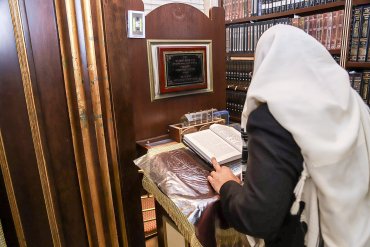
Okay, so there are three daily prayer services in Judaism – Shacharis, Mincha and Maariv, recited morning, afternoon and night, respectively. We’ve been following this schedule for literally millennia, but what are the origins of these prayer services? The Talmud (Brachos 32b) offers two opinions. The first is that these three prayer services were instituted by the Patriarchs – Shacharis by Avraham, Mincha by Yitzchak, and Maariv by Yaakov. This is inferred from the following verses:
- “Avraham arose early in the morning (and went) to the place where he had stood before Hashem” (Genesis 19:27);
- “Yitzchak went out to meditate in the field toward evening” (Genesis 24:63);
- “He (Yaakov) encountered the place and he slept there because the sun had set” (Genesis 28:11).
Other verses are cited to contextualize that the verbs “stood,” “meditate” and “encounter” refer to prayer, but let’s take that as a given for our purposes.
The other opinion is that the three daily prayer services correspond to the daily offerings that were brought in the Temple. One of these was brought in the morning and the other in the afternoon (Exodus 29:39).
“A-ha!” I hear you exclaim (well, not really). “There are three daily services but there were only two daily offerings!” Yes, that’s true. According to this opinion, the nighttime service corresponds to the burning of the limbs and fats of the offerings on the altar, which took place overnight.
Now, here’s something I learned decades ago, but for which I cannot cite a source, so perhaps some learned reader can provide one. When we pray, we recite the individual Shemoneh Esrei prayer at all three services, but the public repetition of the prayer is only recited at Shacharis and Mincha. I learned that the three private recitations correspond to the prayers of our Patriarchs, while the two public repetitions correspond to the two daily communal offerings. But this idea isn’t the way it’s presented in the Talmud and I don’t know who originated such an interpretation.
Anyway, no matter how you slice it, one prayer is recited in the morning, one in the afternoon and one at night. These times need to have definitions. The morning Shemoneh Esrei cannot be recited before what’s called haneitz hachama. Typically translated as “sunrise,” this is when the top of the sun becomes visible at sea level. (People commonly refer to this time as “neitz,” but that’s incorrect. The word is “haneitz,” “ha” being part of the word and not the prefix meaning “the.”)
It should be noted that reciting the Shema also has time limits. Deuteronomy 6:7 tells us to recite this prayer “when you lie down and when you rise up.” This doesn’t mean when you personally go to bed and get up, it means at the times when people normally do these things. The very first topic of conversation in the Talmud is the question of the appropriate times to recite the Shema. (The time to recite the morning Shema is what’s called misheyakir. This is when it’s light enough for a person to recognize a casual acquaintance from a distance of four cubits, or about six feet, so pitch black is too early for this, as well).
So, yes, the ability to pray before work in the winter would be seriously impeded by permanent Daylight Savings Time.
Now, as promised, I’m going to wax political. The Jewish population of the US is tiny, and the Orthodox population is minuscule. Frankly, I can’t see our inconvenience being a significant enough factor in deciding whether or not to make Daylight Savings Time permanent, but there are other considerations.
Daylight Savings Time was a temporary measure that has long outlived its usefulness, and most Americans want to do away with it, but they’re split about whether to make Daylight Savings Time or Standard Time the new permanent time. The advantage of Daylight Savings Time is that it’s better for the economy – businesses love that extra hour of daylight for shopping. (And candymakers really love that extra hour of daylight for trick-or-treating!) But the cost might be too high.
Nobody wants to get up in the pitch black in December and wander around in the darkness until sunrise at 8:00 in the morning. It wreaks havoc with our circadian rhythms. And there’s also the issue of kids having to go to school in the dark.
Memories are short. We tried permanent DST in 1974 and it led to an epidemic of kids being hit by cars on their way to school. After eight Florida students had been killed in traffic accidents, Governor Reubin Askew asked Congress to repeal permanent DST. Senator Dick Clark of Iowa told Congress, “It’s time to recognize that we may well have made a mistake.” “Permanent” Daylight Savings Time lasted six months.
So, yes, I oppose the twice-annual clock changes – that’s not great for our circadian rhythms, either – but I don’t think permanent DST is the way to go. I favor permanent standard time, for reasons completely unrelated to the imposition on prayer times.
Sincerely yours,
Rabbi Jack Abramowitz, JITC Educational Correspondent
Educational Correspondent
Follow Ask Rabbi Jack on YouTube
If you found this content meaningful and want to help further our mission through our Keter, Makom, and Tikun branches, please consider becoming a Change Maker today.

 Related posts