
Meet the Non-Jewish Barber Breaking Down Barriers with Orthodox Jews, Online and Off
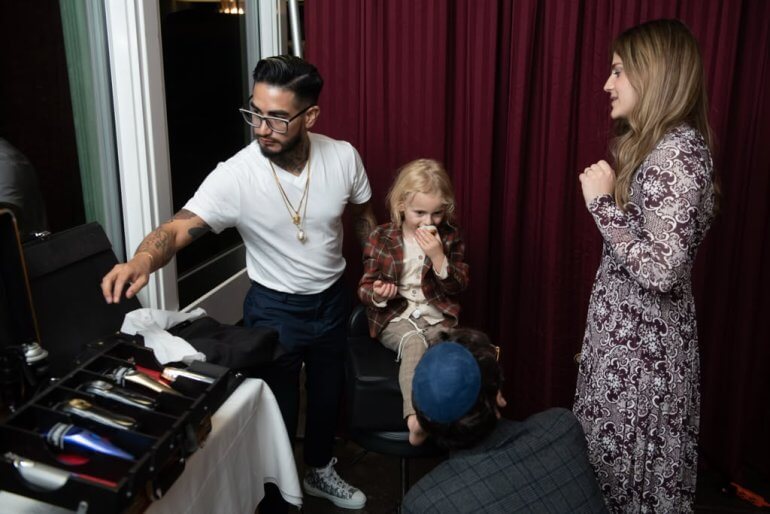
Scroll through Ricardo Camuendo’s social media videos, and you’ll find an Ecuadorian barber cutting the hair of Orthodox Jewish men, carefully working around their peyot (sidelocks) and accommodating the different customs and preferences of his clients.
You’ll also find something less heartwarming in the comment section: hateful remarks directed at the very people sitting in his chair. But Ricardo, known online as Ricky’s Refine, has no intention of letting strangers on the internet dictate who his clients are or how he treats them.
“I don’t want negativity from people on the internet to determine who I can work with or who I can be friends with,” he said. “I’m not going to hide people who have supported me and become an important part of my story.”
Ricardo immigrated to the United States from Ecuador a decade ago, initially working alongside his father installing carpets before deciding to pursue barbering. He got his start at a salon in Spring Valley, New York, before moving to a barbershop in nearby Airmont, where he first encountered Orthodox Jewish clients.
When COVID-19 forced barbershops to close, Ricardo began cutting hair from his home, eventually converting part of his garage in Monsey into a dedicated barbering space. In the heart of Rockland County’s large Orthodox Jewish community, his business began to grow through word-of-mouth recommendations. “One client would recommend me to another, and then that person would recommend me to someone else,” Ricardo recalled. “Slowly, my Jewish clientele continued to grow.”
Today, Ricky’s Refine is known for its upscale, VIP-style barbering experience. Ricardo has transformed his shop into a swanky space where clients are treated to much more than a standard haircut, complete with coffee, under-eye patches, nose masks, and other pampering touches. It’s an experience he takes pride in, and one that has attracted clients from well beyond Monsey. Some drive hours for an appointment, while visitors from as far away as California and Israel have made a point of stopping in for a haircut.
But beyond the luxurious extras, it’s Ricardo’s attention to his clients’ individual needs that has helped him build such a loyal following. For many Orthodox Jewish men, a haircut involves more than choosing a length or style. Jewish law places restrictions on cutting the hair at the sides of the head, and different communities observe distinct customs regarding peyot. Ricardo, who hadn’t grown up around Orthodox Jews, quickly realized he had a lot to learn.
“My clients were really my teachers in that sense,” he explained. “They would explain to me what they wanted, show me where they wanted me to cut and where they didn’t, and over time I became more familiar with the different customs.”
He learned to pay attention to the smallest details, recognizing that something another barber might overlook could carry significant religious importance. “I have always believed that if a client trusts me with his haircut, I have a responsibility to respect what is important to him.”
Some clients admitted that they had initially been hesitant to visit a non-Jewish barber, unsure whether he would understand their religious requirements. But Ricardo’s attentiveness gradually earned their confidence. He’s even been invited into families’ homes to perform upsherins, the traditional first haircut ceremony for three-year-old Jewish boys.
“I especially remember some clients who have told me that they no longer see me as just their barber, but as someone they trust,” he shared. As Ricardo became more familiar with his clients’ customs, he also began getting to know the people behind them. “What surprised me the most was realizing that, before I got to know them personally, I had many ideas about the Jewish community that I really didn’t understand,” he admitted.
Through conversations about family, work, and everyday life, Ricardo developed a deeper appreciation for the importance of faith, tradition, and community in his clients’ lives. And the learning went both ways.
Some of his Orthodox Jewish customers told him that getting to know him had challenged assumptions they held about people outside their community. As Ricardo learned about their customs, they learned about his experiences as an immigrant from Ecuador.
“I’m learning about their culture, and they’re learning about mine,” he said. “I think that is one of the most powerful things about being a barber,” Ricardo reflected. “You can have two people from completely different backgrounds sitting in the same chair, talking like friends.”
Ricardo regularly shares videos of his work, including haircuts featuring his Orthodox Jewish clients. Unfortunately, those posts have also attracted antisemitic commenters.
“Of course, it is difficult sometimes to read hateful comments, especially when those comments are directed at people I know personally and respect,” he acknowledged. But the negativity hasn’t changed his perspective.
“When I post my work, I’m simply showing what I do every day,” he said. “I continue showing my Jewish clients because they are an important part of my journey as a barber. They gave me an opportunity, they trusted me, and many of them helped me grow my business by recommending me to their friends and family.”
If you found this content meaningful and want to help further our mission through our Keter, Makom, and Tikun branches, please consider becoming a Change Maker today.

 Related posts