


Was The Passover Episode Of Your Friends And Neighbors Good Jewish Representation?
The Jewish internet has been abuzz about “Bread of Affliction,” the recent episode of Apple’s Your Friends and Neighbors, which aired closer to Lag B’Omer than Passover, but who’s counting? Actually, lots of people! (Google “sefiras haomer” if you didn’t get that!) What I saw repeated over and over again was how authentic and detailed the seder was – and it was. Jonathan Tropper, one of the show’s creators, was raised modern Orthodox, so it makes sense that so many of the rituals were accurate.
Because our Hollywood Bureau conducted the most extensive research on Jewish television representation in twenty-five years with USC’s Norman Lear Center, we have a specific approach to grading Jewish content. When we look at an episode, we’re not only looking for authenticity. We look at casting, tropes, identity and more. There are wonderful things about the episode beyond authenticity and a few things I would recommend doing differently next time.
The Good
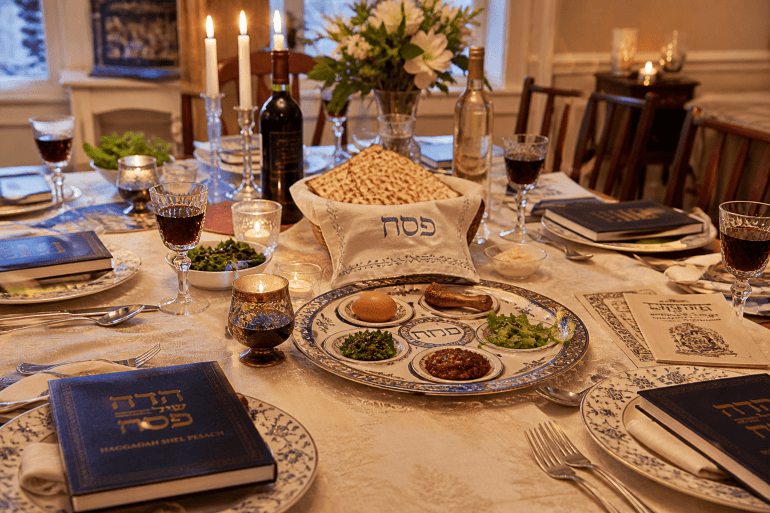
Coop, played by Jon Hamm, introduces us to a Passover seder, and the vibe is that it’s cool. His character appreciates lots of wine and celebrating freedom. The table scape is beautiful, the people are engaged with the seder and seen laughing and enjoying throughout. While Jewish holidays are often seen as less than Christian holidays on TV, this is a welcomed departure. When Sam Levitt, played by Olivia Munn, walks into the house and her appearance is seen as controversial, a Jewish woman named Gretchen has compassion for her, doesn’t want to embarrass her and wants to be hospitable. Authentic Judaism on screen isn’t only about representing rituals accurately, it’s also showcasing Jews living with Jewish values. Well done!
Let’s get to the authentic rituals. The hagaddahs are the kind that you’d find in a mainstream Judaica house, not the free Maxwell House version. Gretchen recited an entire kiddish and did it well. I’ve never seen all of kiddush ever said anywhere. They used -Shmura Matza – a more traditional kind – and broke it, as the seder calls for. “All who are hungry come eat,” was said and, “why is this night different from all other nights” was referenced, ma nishtana was sung. We saw the guests dip karpas in salt water, take wine out of their cups as they recited all ten plagues, eat marror on their Matza and comment how hot it was. They noted that you are supposed to drink four cups of wine and sang some Dayenu. Even the afikomen – which they correctly called “dessert” – was found. There were many, many elements to the seder included and they were all referenced in an accurate way! As a bonus, we saw a non-white passing Jew at the seder and she is played by a Jewish woman. Jewish joy, authenticity, diverse casting, authentic casting, proud Jewish identity front and center – these are all things our study recommended more of. This episode did it.
The Less Good
There’s not too much I would have changed. The first comment I noticed that bothered me wasn’t a Jewish thing specifically, it was about religion in general. Before Coop praises the Passover seder, he notes that he doesn’t like organized religion. This is a thing I see happen often in Hollywood before a Jewish thing is about to happen. In a recent episode of another show that has received a lot of praise for Jewish representation, before the character says a prayer, he notes that he’s not even sure if he believes in God. It feels like the writers are afraid to do something Jewish without an apology or qualification. Just own it. It’s good to be Jewish!
One thing our study picked up on is that Jews are often shown as wealthy and elite on screen. Showing money on screen is kind of a thing that happens often in Hollywood for many groups. But when Jews are depicted this way, it can reinforce stereotypes. Same thing with elite jobs and education. We learn that Coop’s daughter has turned down Princeton in the episode. Better to not have Jewish characters centered around money and elite institutions. Additionally, when Sam Levitt’s character walks in, we see the Jewish women in the kitchen gossiping and being yentas, another common Jewish female trope.
Our study picked up that only around half of Jewish parts are played by confirmed Jewish actors. That statistic seemed to apply in this episode too. We can do better than that. There is also a lot of intermarriage among the characters. Yes, it is common in real life and also, viewers should get to see two happily married Jews sometimes. Last but not least, one of the non-Jewish husbands speaks about the second seder with derision, but of course lots of Jews talk that way in real life!
All in all, this was a very solid episode in terms of Jewish representation. I feel hopeful for an increasing awareness among showrunners and writers to keep improving, showing authenticity and Jewish pride and joy!
If you found this content meaningful and want to help further our mission through our Keter, Makom, and Tikun branches, please consider becoming a Change Maker today.

 Related posts