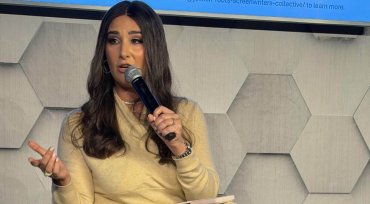

Actor Simon Feil Speaks Out On Jewish Stereotypes in Hollywood
When Jew in the City released our now-viral Like a Jew video, actor Simon Feil didn’t stop at “liking” it — he recognized himself in it, and said so publicly.
“This is so hard to watch because I do it too,” he wrote in a comment that immediately stood out. “I’ve learned what the industry wants—stereotypes. How have we allowed ourselves to continue to be reduced to the worst, shallowest stereotypes of ourselves? Why are these allowed to persist, to thrive?”
Feil has spent nearly two decades working in film and television, a path he partly chose because, as he explained, “I’m Shomer Shabbat, and theater was really, really difficult.” Over the years, he’s appeared in projects including Ocean’s Eight, Orange Is the New Black, Inside Amy Schumer, and The Blacklist. And throughout that career, he’s encountered Jewish stereotyping in ways that are both overt and subtle.
For a long time, he said, he wasn’t cast as Jewish at all. “I actually was not allowed to play Jews for the longest time,” he explained. He would see casting breakdowns for roles that required “some Jewish knowledge” and ask his representatives to submit him, only to be told he didn’t have the “right look.”
“I said, oh—so they’re saying I don’t look like the thing that I am,” Feil recalled. “They have some idea about what a Jew is, what a Jew looks like, and I don’t fit it.”
Even when casting did want someone Jewish, the request was often vague and loaded. Feil described seeing breakdowns that asked for a “Jewish accent,” and pressing for clarification. “Do you mean a Yiddish accent? A Brooklyn accent? An Israeli accent?” he asked. The response, he said, was usually hesitation. “They didn’t know how to put into words the thing that they wanted.”
Sometimes the stereotyping surfaced through small changes with big implications. “I got a script change where the only difference was that my character’s name was made more Jewish,” he said. “There was nothing inherent in the role, but I wasn’t playing a good person.”
Other moments were more blunt. Feil recalled booking a role that required an Israeli accent and explaining he didn’t know how to do one. “My rep said, ‘But you’re Jewish,’” he remembered. “And I was like, that is true—and those are different things.”
Over time, Feil tried to bring intention and humanity into these roles by asking where a character was from, or modeling speech after real people he knew. But he also acknowledged something harder to admit. “What I wrote in that comment is true,” he said. “I found myself doing it.”
He’s careful to point out that the issue isn’t that stereotypical Jews don’t exist. “Those stereotypes don’t come out of nowhere,” he said. “There are people who speak like that. It’s not a question of, that’s not a Jew.”
The problem, Feil emphasized, is what happens when one narrow version becomes the default. When audiences see the same portrayal again and again—whether it’s the exaggerated accent, the Orthodox character fleeing their life, or the Jew associated with financial wrongdoing—it shapes how Jews are understood.
For Feil, the way forward begins by slowing the moment down and demanding clarity. “When someone says ‘act Jewish,’ my response is always ‘tell me what you’re really asking,’” he said. “Force the conversation.”
The goal isn’t to sanitize Jewish characters or make them less complex. It’s to widen the frame and to allow Jews to appear on screen as fully human, without having to perform someone else’s assumptions.
That, Feil believes, is why Like a Jew resonated so deeply. It didn’t shame or accuse. It reflected something many people, actors included, had internalized but never named. And by holding up that mirror, it opened a long-overdue conversation about how Jews are seen, cast, and reduced.
But with actors like Feil willing to speak honestly, and with Jew in the City continuing to push the industry toward nuance and truth, the work of changing that picture has finally begun.
If you found this content meaningful and want to help further our mission through our Keter, Makom, and Tikun branches, please consider becoming a Change Maker today.

 Related posts