


NYT Magazine Op-Ed on Jewish Invisibility in Biopics: Our Research Agrees
Mireille Silcoff, an author and cultural critic who lives in Montreal recently penned a poignant piece for the New York Times Magazine: There’s Something Missing in Films About Jewish Cultural Figures. In it, she describes how Jewish identity is missing from all the major Jewish biopics of late, be it Oppenheimer, about Robert J. Oppenheimer – father of the atomic bomb, Maestro, about famed composer, Leonard Bernstein, Golda, about former prime minister of Israel, Gold Meir, A Complete Unknown, about singer Bob Dylan, and most recently Song Sung Blue about the people who loved singer Neil Diamond.
One of the most notable lines of this piece is: In each movie, some bid for universality trumps the representation of Jewish experience, leaving behind a peculiar Jew-shaped hole: The stories are about us, but we’re not in them.
JITC (Jewish Institute for Television & Cinema) Hollywood Bureau has certainly noticed this phenomenon, and has additionally noticed the lack of authentic Jewish casting in most of these films, with the exception of Timothee Chalamet as Bob Dylan. Then again, most films about Jews involve the Holocaust, another troubling trend, since the Jewish experience is not only one of genocide and trauma. It also spans thousands of years, not half a dozen. So perhaps, even inauthentically cast films about Jews with Jewish erasure at least is some form of progress?
A major reason why this op-ed caught our attention is because it reinforces in film what our research found in contemporary television. We can quantify Jewish erasure in television. In collaboration with the Norman Lear Center at USC, Jewish Institute for Television & Cinema studied 108 Jewish characters across 15 television series commonly understood to be “Jewish shows.” The researcher’s bar for who is a Jew was extremely high, meaning anyone simply coded Jewish was not picked up in the analysis. One of the most striking findings in the aptly named “Jews on Screen” study was that fewer than one in five characters explicitly identified as Jewish on screen. Jewish identity was frequently implied, softened, or left unspoken. When Jewish professionals and Orthodox Jews (two categories of characters brought into storylines to be explicitly Jewish) were removed, only 13% of Jewish characters acknowledged being Jewish.
We began the study expecting to document familiar tropes, which we found. However, the most consistent pattern we found (but didn’t expect) was the absence of clear Jewish self-identification, even in narratives centered on Jewish life. If cultural misunderstanding is shaped not only by what is shown but by what is omitted, this pattern is troubling.
In an age where every other minority group is leaning in and being out and proud, the erasure of Jewishness is especially acute. The author bemoans: “I would hate to think that this is because we have, in recent years, been deemed too problematic, too difficult to relate to or hard to like, for mainstream consumption.” I fear that this is the case from both the Jewish and non-Jewish creative’s perspective as well as due to studio feedback.
Silcoff notes that a generation ago: “parts of the Jewish experience were absorbed into the mainstream, until millions of Americans could watch TV shows steeped in Jewish humor and sensibilities, like “Seinfeld,” and think of them only as New Yorkers Being Very New York. Somewhere along the path from “Goodbye, Columbus” and “The Odd Couple” to Judy Blume and “An American Tail,” from “Dirty Dancing” to Jon Stewart’s “The Daily Show” to “The Marvelous Mrs. Maisel,” the Jewish experience became capable of blending, sometimes invisibly, into the broader American one.”
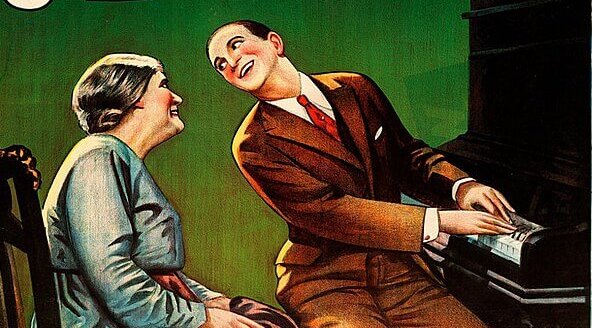
My sense is that Silcoff finds the Jewish blending, even if sometimes invisibly, to be better than the Jewish erasure she noticed in biopics. I would agree, but still it’s not great. She closes the piece remembering The Jazz Singer, and from what I understand, she sees this as a quintessential Jewish film. Perhaps this is the one place she and I depart in our opinion on films. Yes, the story of the cantor’s son leaving the fold, is part of American Jewish history. It is the story of assimilation and intermarriage and leaving the traditions from the Old Country. But is this not yet another form of Jewish erasure? In our age of leaning in and being out and proud you could and should be able to be a very Jewish and very successful American.
Where is the film about the jazz singer who is completely connected to his Jewish roots and traditions AND is a famed singer in the secular world? That’s a film that I’d like to see produced. Perhaps it could be about the life of Shulem Lemmer, the first Hasidic born singer signed by a major label (Universal). (Watch our clip of his story here.)
If you found this content meaningful and want to help further our mission through our Keter, Makom, and Tikun branches, please consider becoming a Change Maker today.

 Related posts




2 comments
Sort by
I would suggest it should be about the life of Yossele Rosenblatt, who actually had a singing role in The Jazz Singer itself, and remained Frum
Love it!